
2026 Event Materials
Guidance for Participation
2026 Social Media Video 1
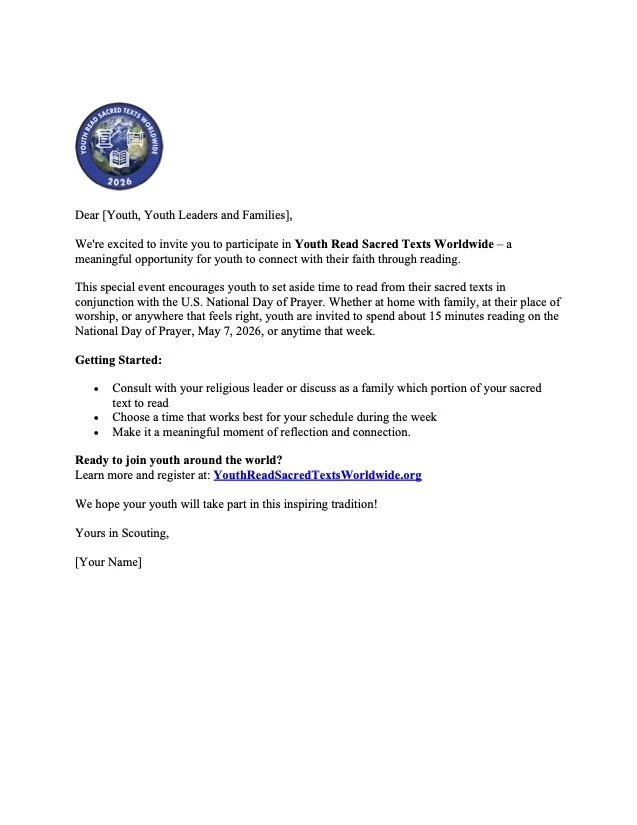
2026 Email Invitation
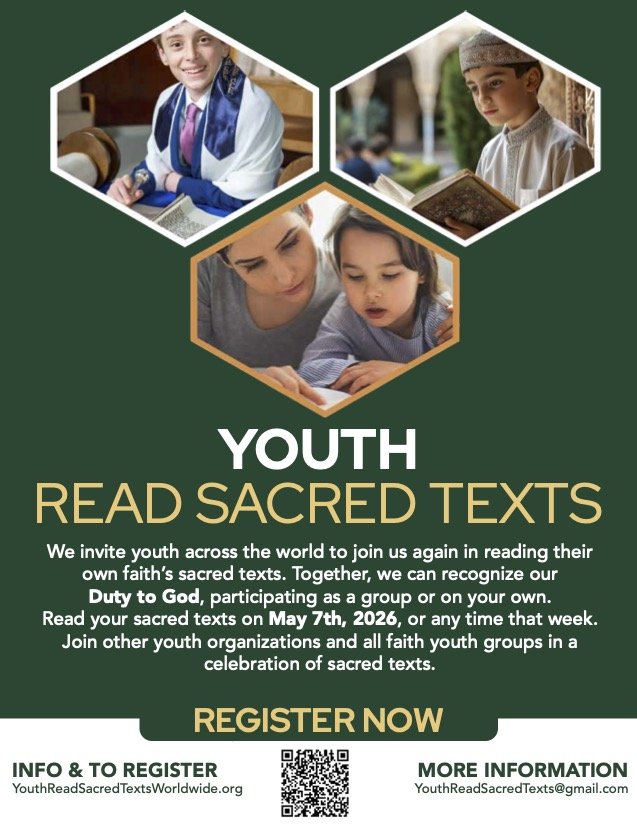
2026 General Youth Flyer
2026 PowerPoint Presentation
2026 Social Media Video 2
2026 Faith & Youth Group Materials
2026 Logo

2026 Social Media Video 3
Youth Read Sacred Text Worldwide - Event Guidance
Faith-Specific Guidance
Interfaith Contexts and Multifaith Families
Interfaith participation—whether organizational or within multifaith families—is structured as parallel engagement, not shared worship.
Key principles:
Each tradition reads only its own sacred texts
No theology is blended, compared, or evaluated
Participation is voluntary and adult-guided
Focus remains on peace, ethics, service, and respect
Families with more than one faith tradition may choose to participate separately but concurrently, honoring each tradition’s integrity.
Jewish Synagogues, Youth Programs, and Families
For Jewish communities and households, Youth Read Sacred Texts Worldwide aligns naturally with text study and ethical reflection, both communal and home-based.
Common uses include:
Bar or Bat Mitzvah preparation
Hebrew school or youth group study cycles
Family Torah study or Shabbat discussion
Ethical reflection connected to Jewish holidays
Assurances:
Texts are selected locally or by families
No interfaith blending, shared worship, or comparative theology
Rabbinic authority and parental responsibility are respected
Participation may be private and household-based
Christian Churches, Youth Ministries, and Families
Youth Read Sacred Texts Worldwide may be used as a youth-led Scripture-reading and reflection opportunity, guided by church leadership or by parents in the home.
Common uses include:
Confirmation or discipleship preparation
Youth group or retreat Scripture focus
Family Bible reading during Advent, Lent, or summer
Parent-guided reflection connected to sermons or lessons
Assurances:
No outside doctrinal instruction is provided
Scripture selection and interpretation remain local or family-directed
Participation is optional and adaptable
The initiative does not replace worship, Bible study, or church teaching
Muslim Mosques, Islamic Youth Groups, and Families
Youth Read Sacred Texts Worldwide may be used as youth-led Qur’an reading and reflection, guided by Imams, youth leaders, or parents.
Common uses include:
Mosque youth nights or weekend classes
Family Qur’an reading at home
Ethical instruction and character development
Preparation during Ramadan or other teaching periods
Assurances:
Participation is mosque- or family-led
No public or interfaith component is required
Emphasis remains on discipline, ethics, and personal growth
No media involvement or external visibility is expected
Quaker - Spanish Invitation
Youth Read Sacred Texts Worldwide may be used as youth-led Qur’an reading and reflection, guided by Imams, youth leaders, or parents.
Guidance For Families
Youth Read Sacred Texts Worldwide is a simple, family-guided way to encourage young people to read and reflect on the sacred writings of their own faith tradition at home.
Families may participate independently, alongside a faith community, or in coordination with a youth program—always in a manner consistent with their beliefs, practices, and household rhythms.
This initiative is intentionally:
Family-guided
Faith-specific
Optional and flexible
Non-commercial and non-political
It is not a curriculum or lesson plan. It is a framework that allows parents and caregivers to guide meaningful sacred reading in a way that feels natural and appropriate for their family.
Why Families Choose to Participate
Many families want to help their children:
Spend time with sacred texts beyond formal classes
Develop habits of reflection, discussion, and ethical thinking
Connect faith teachings to everyday life
Prepare for milestones such as confirmation, bar/bat mitzvah, or other rites of passage
Youth Read Sacred Texts Worldwide offers a low-pressure, adaptable approach that fits into family life without replacing religious education, worship, or community involvement.
How Families Typically Use This at Home
Families often incorporate Youth Read Sacred Texts Worldwide into:
Weekly family devotional or study time
Sabbath or holy-day discussions
Bedtime or weekend reading
Preparation for religious milestones
Seasonal faith observances
Quiet reflection during significant times of the year
Participation can last a single week, a month, or a season. There is no required schedule, reporting, or public participation.
A Simple Family Approach
Many families find this structure helpful:
Choose a text appropriate to your faith and your child’s age
Set aside time to read together or individually
Invite reflection, conversation, or journaling
Connect meaning to values, ethics, or daily life
There is no “right way” to participate—only what works best for your family.
Families and Faith Communities
Some families choose to participate entirely at home. Others align their reading with:
What youth are learning in religious education
Sermons or teachings at their place of worship
Youth group themes or seasonal observances
Both approaches are fully consistent with Youth Read Sacred Texts Worldwide.
A Gentle Word to Parents and Caregivers
You do not need special training, materials, or approval to participate. Your role as a parent or caregiver is already central to your child’s faith formation.
Youth Read Sacred Texts Worldwide exists to support families in that role—not to replace it.
Guidance For Global Participants
Youth Read Sacred Texts Worldwide is intentionally designed to be used by youth, families, and faith leaders in many countries, cultures, and legal contexts. Because religious practice, education systems, and public expression vary widely around the world, participation is guided by a small set of universal principles rather than uniform rules.
A Global, Local-First Approach
Youth Read Sacred Texts Worldwide is not a centrally directed program. It is a locally guided framework that adapts to:
National and local laws
Cultural customs and sensitivities
Religious norms and expectations
Family and community structures
What participation looks like in one country may look very different in another. All approaches are valid when they honor local context and tradition.
Respect Local Laws and Customs
Participants should always ensure that activities:
Comply with local laws and regulations, including those governing religious instruction, youth activities, and gatherings
Respect cultural norms related to family, education, and religious practice
Follow parental consent and supervision expectations appropriate to the local context
In some regions, participation may be private or family-based rather than public or organized—and that is fully consistent with the initiative.
Faith-Specific Practice Comes First
Across all countries:
Youth engage only with the sacred texts of their own faith tradition
Text selection and interpretation are guided locally
There is no interfaith worship, blending of theology, or comparative study
No faith tradition is represented or interpreted by another
These boundaries help ensure respect, safety, and trust in diverse religious environments.
Family-Guided Participation Is Always Appropriate
In many parts of the world, families are the primary context for faith formation. Youth Read Sacred Texts Worldwide explicitly affirms:
Parent- or guardian-guided participation at home
Extended family involvement where customary
Small, informal groups when appropriate
Family-based participation may be the preferred or safest option in some countries.
Leadership and Authority Vary by Culture
Different cultures place authority in different roles. Participation may be guided by:
Clergy or faith educators
Parents or grandparents
Elders or community leaders
Teachers or mentors approved by families
Youth Read Sacred Texts Worldwide respects whoever is recognized locally as the appropriate guiding adult.
Public vs. Private Participation
There is no requirement that participation be public, reported, or visible.
Depending on local context, participation may be:
Entirely private (home-based)
Limited to a small trusted group
Integrated quietly into existing education or worship
Seasonal or occasional rather than ongoing
All of these are consistent with the initiative.
Language, Materials, and Translation
Participants are encouraged to:
Use sacred texts in their original language or in trusted translations
Adapt discussion and reflection to local language and age norms
Translate or summarize materials as needed for youth understanding
There is no expectation that materials be used in English.
Safety, Care, and Youth Wellbeing
Across all countries, guiding adults should:
Ensure youth safety and wellbeing
Follow local norms for supervision and safeguarding
Be attentive to age, maturity, and emotional needs
Keep participation voluntary and respectful
What Is Shared Globally—and What Is Not
Shared globally:
Respect for sacred texts
Local control and authority
Voluntary participation
Faith-specific engagement
Not required globally:
Reporting
Public events or publicity
Common schedules or calendars
Central oversight or direction
A Note to International Participants
Youth Read Sacred Texts Worldwide exists to support faith formation wherever it already happens, in ways that are appropriate, lawful, and respectful in each country. If you are unsure how to participate in your local context, the guiding principle is simple:
Follow your faith tradition, your family or community’s guidance, and your local laws. That approach is always consistent with Youth Read Sacred Texts Worldwide.
Guidance For Faith Leaders and Youth Directors
Youth Read Sacred Texts Worldwide is a flexible, values-centered opportunity for young people to engage deeply with the sacred writings of their own faith tradition. It is intentionally designed to be locally led, optional, and fully aligned with the practices of each faith community—whether guided by clergy, youth leaders, or families.
The initiative provides a framework—not a curriculum. Sacred text selection, interpretation, discussion format, and timing remain fully under the guidance of faith leaders and families, according to what best fits their tradition and household or community life.
Participation is always:
Youth-focused
Leader- or family-guided
Locally controlled
Faith-specific
Non-commercial and non-political
A Leader-First and Family-Affirming Model
Across faith traditions, meaningful youth formation most often follows trusted adult leadership. Parents look to clergy, youth directors, and faith educators for guidance—and many families also practice sacred reading and reflection at home as part of their religious life.
For this reason, Youth Read Sacred Texts Worldwide supports two complementary pathways:
Faith-leader–guided participation through congregations, mosques, synagogues, and youth programs
Family-guided participation within homes, extended families, or small informal groups
Both pathways honor faith tradition, parental responsibility, and local control. There is no requirement that participation be institutional, public, or organized beyond what leaders or families deem appropriate.
How Communities and Families Commonly Use This Initiative
Youth Read Sacred Texts Worldwide is often integrated into existing rhythms such as:
Confirmation, profession of faith, or catechetical preparation
Bar or Bat Mitzvah study cycles
Mosque youth nights, weekend classes, or Ramadan preparation
Seasonal religious education programs
Family devotional time, Sabbath observance, or home study
Retreats, service learning, or ethical formation units
Some families participate independently at home; others align their family reading with what their faith community is doing. Both approaches are fully consistent with the initiative’s intent.
Frequently Asked Questions (FAQ)
Is this only for organized religious groups?
No. Youth Read Sacred Texts Worldwide may be used by congregations, youth programs, or families at home.
Do families need approval to participate?
No. Families may participate independently, in a manner consistent with their faith and values.
Is this a curriculum or lesson plan?
No. It is a framework that allows leaders and families to decide how to read and reflect.
Is this interfaith worship?
No. Each tradition engages only with its own sacred texts.
Is participation public or reported?
No. Participation may be entirely private.
Does this replace religious education?
No. It complements existing programs and family practice.